Complete Guide to Unified Money Management for Individuals and Businesses
By ScaleBlogger
The Complete Guide to Money Management in 2026 states that about 69% of Americans lived paycheck to paycheck in 2025. This situation may have changed since then. Research from Financial Planning in 2026: A Fresh Start Guide found that 86% of Americans said they had a budget.
The problem often isn’t about effort. It is about the gap between making a financial decision and showing what happened next.
A budget can show how money was used.
However, a budget does not always show if a payment was approved, if you kept the receipt, or if you recorded the expense correctly.
Businesses face the same issue when bank activities, invoices, payroll, and accounting records are disconnected.
Unified money management bridges that gap by linking your financial actions to the evidence that supports them.
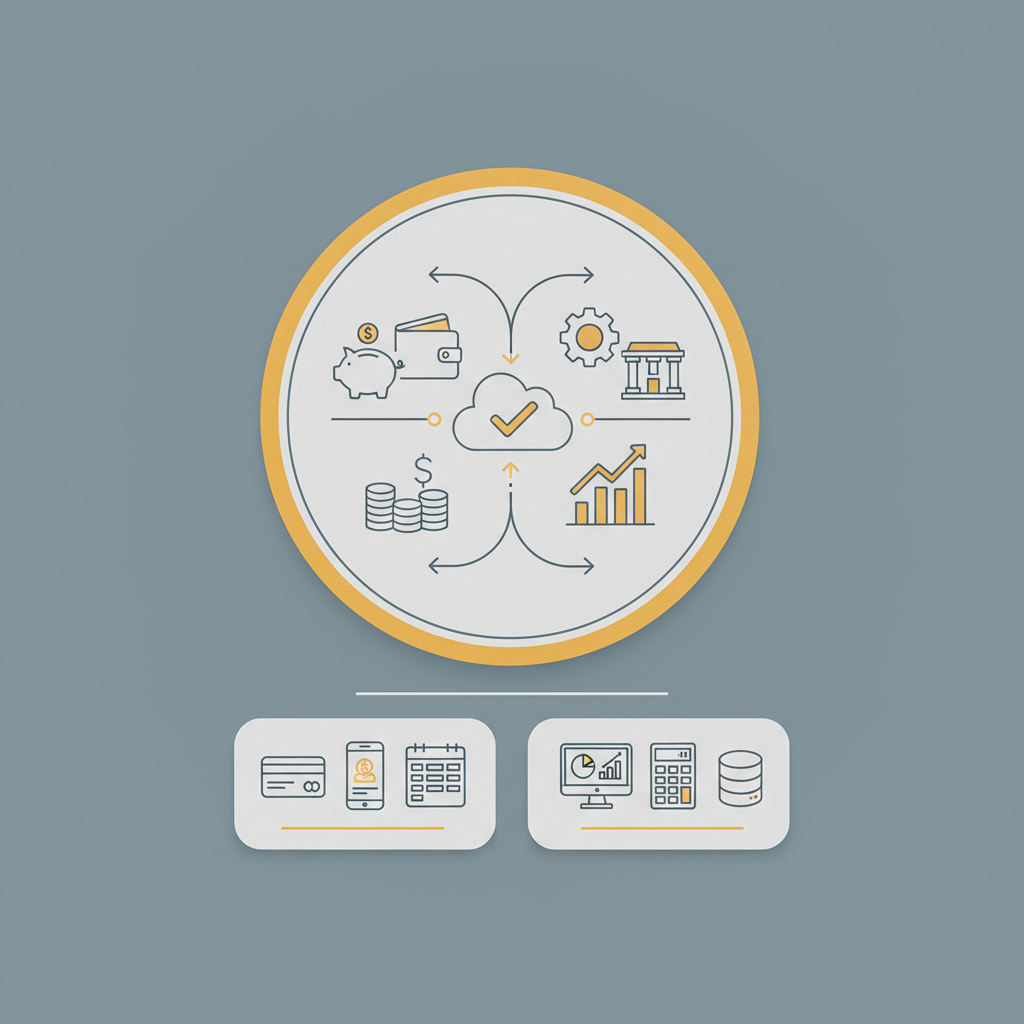
It combines planning, payments, approvals, records, and account balances into one trusted system. This way, it avoids treating each task as a separate job.
For individuals, this means improved control over bills, debts, savings, and unexpected expenses.
For companies, unified financial management for businesses means stronger oversight, cleaner handoffs, and records that support decisions rather than merely report them later.
This difference is important when choosing money management and accounting software.
A dashboard may show your current balance. But a connected system can explain why that balance changed, who approved it, and if the record is reliable.
Quick Answer: Unified money management is essential for both individuals and businesses facing economic challenges. It effectively connects financial actions with their supporting evidence, enhancing financial oversight and accountability. Implementing a system that integrates budgeting, expense tracking, and accounting can significantly improve control over bills, debt, and unexpected costs while ensuring accurate record-keeping.
How to Use This Guide: Choose Your Money Management Path
In 2025, 69% of Americans lived paycheck to paycheck. This was despite 86% claiming they had a budget, according to The Complete Guide to Money Management in 2026.
The gap often isn't a lack of effort. Budgets, approvals, receipts, bank accounts, and accounting records are often in different systems.
To solve these issues, choose the path that fits your role and immediate goal:
- Individuals: Begin with income, bills, spending, savings, and debt. Keep receipts or confirmations for transactions that might be important later, such as tax expenses or reimbursements.
- Growing businesses: Concentrate on approval controls, documenting expenses, reconciliation, and ownership. A good control might involve getting a manager’s approval along with a receipt before recording a payment.
- Multi-currency teams: Monitor the original currency, conversion rate, date, and accounting treatment. Mid-market FX refers to the benchmark rate between buying and selling prices in the market; it isn't always the final rate your provider charges.
- Finance leaders: Focus on a trustworthy audit trail, which means a time-ordered record of actions, approvals, supporting documents, and changes.
Accounting records also need careful attention. Double-entry bookkeeping records each transaction with at least one debit and one credit, keeping the books balanced.
This method is more detailed than a spending dashboard, helping connect operational activities to financial statements.
Follow the guide in three simple steps:
- Identify the friction: Locate where duplicate entries, missing evidence, late approvals, or inconsistent exchange rates delay decisions.
- Set control points: Decide who approves spending, what documents are required, and when reconciliation occurs.
- Measure readiness: See if someone else—like an accountant, auditor, lender, or finance leader—can understand and verify the record.
Our approach at Fullness brings budgeting, payment tracking, evidence, double-entry books, and shared FX references into one financial operating system.
The guide covers those connections, but it does not replace jurisdiction-specific accounting advice, lender requirements, tax guidance, or professional review.
Choose the path closest to your role, then expand as your financial activity becomes more complex.
The goal is not just to have another dashboard; it is to create a record you can trust, explain, and use responsibly.
Unified Money Management Foundations
Having a reliable financial record is important because in 2026, about 38% of Americans saw unexpected expenses as a major concern, according to The Complete Guide to Money Management in 2026.
Unified money management links each transaction to its purpose, approval, evidence, accounting method, and future reports. It involves more than just combining bank feeds or changing spreadsheets. It creates a single operating record for personal and business finances. This helps users to track transactions, provide context, and make better decisions.
Fragmented administration versus a unified record
| Capability | Fragmented approach | Unified approach | Operational benefit |
|---|---|---|---|
| Transaction tracking | Activity sits across banks, cards, spreadsheets, and apps | Transactions follow one controlled record | Fewer gaps and duplicate entries |
| Approvals and supporting evidence | Emails, receipts, and approvals remain separate | Evidence attaches to the related financial action | Faster review and clearer accountability |
| Double-entry bookkeeping | Bookkeeping occurs later in another system | Each transaction maps to accounts and entries | More dependable balances and reconciliation |
| Currency conversion | Different tools use different rates or dates | A defined reference rate supports conversion and reporting | Consistent multi-currency records |
| Credit and audit documentation | Staff assemble records when requested | Documentation accumulates during normal work | Less preparation and stronger traceability |
A budgeting app might show where money went, but accounting records explain how the transaction affects assets, debts, income, or expenses. A dependable record rests on five connected building blocks:
- Movement: the amount, date, account, payer, and recipient.
- Purpose: the business reason, personal goal, category, or obligation.
- Authority: who approved the action and under which policy or limit.
- Evidence: receipts, invoices, contracts, statements, or other supporting documents.
- Accounting and context: the double-entry treatment, currency, exchange rate, and reconciliation status.
Proof is crucial because simply tracking movement does not indicate if a payment was valid, approved, correctly classified, or recorded at the right exchange rate. For example, a foreign-currency expense needs both the receipt and the conversion basis before its accounting value can be assessed. For a growing company, this supports unified financial management for businesses without forcing every employee to become an accountant. Individuals benefit from the same discipline on a smaller scale.
Core Methods and Decisions for Building a Unified System
In 2026, 65% of Americans considered a financial resolution, according to The Complete Guide to Money Management in 2026.
Good intentions alone often do not resolve scattered management.
A good system links every movement of money to evidence, ownership, and an accounting result.
Map money before selecting tools
Track how money comes in, moves, and goes out. This includes payroll, payments to suppliers, reimbursements, taxes, debt, savings, transfers, and currency changes.
For each movement, define the owner, approval threshold, required document, payment account, accounting category, and reconciliation point.
This stops budgeting, payment, and accounting systems from having conflicting versions of the same transaction.
Build an evidence-first workflow
Use three stages:
- Track: Record the amount, date, counterparty, purpose, currency, and payment status.
- Prove: Attach the invoice, receipt, approval, contract, or transfer confirmation before finalizing the transaction.
- Unlock: Use the completed record for reporting, tax preparation, lender discussions, or responsible credit assessment.
For example, an expense should move from employee submission through manager approval, payment confirmation, receipt storage, and reconciliation.
Record exceptions, including missing evidence or amended amounts.
Use double-entry as the control layer
Double-entry accounting records every transaction in at least two places, such as cash decreasing while an expense increases.
It reveals omissions and mismatches, instead of just listing the spending.
Medium-sized businesses should reconcile bank, card, accounts receivable, accounts payable, and payroll balances on a defined schedule.
Personal users can apply the same principle to transfers, debt payments, and savings goals without maintaining a formal ledger.
Manage foreign exchange with a repeatable policy
Foreign exchange, or FX, converts one currency into another.
A consistent rate source and documented treatment matter because timing, spreads, and settlement differences can change recorded value.
FX controls checklist
| FX control | Question to ask | Recommended practice | Record to retain |
|---|---|---|---|
| Rate source | Which benchmark determines the rate? | Use a stated provider methodology and timestamp. | Rate quote and timestamp |
| Markup or spread | Is a margin added? | Separate the reference rate from fees or spreads. | Fee disclosure and confirmation |
| Timing of conversion | When is the rate fixed? | Record quote, execution, and settlement times. | Conversion confirmation |
| Accounting treatment | Which value enters the books? | Apply relevant jurisdictional guidance consistently. | Journal entry and policy |
| Settlement | What amount did the other party receive? | Match evidence to the agreed settlement currency. | Recipient confirmation |
| Reconciliation | Does the ledger match the bank or wallet? | Reconcile converted amounts after settlement. | Reconciliation record |
We use shared mid-market reference rates across conversions and records so users can compare decisions consistently.
Evaluate the platform, not just the dashboard
Assess whether software preserves approvals, evidence, double-entry records, and FX history in one chain.
Fullness is designed around that unified financial management model for individuals and growing businesses, while suitability depends on integrations, controls, reporting standards, and lender documentation.
A unified system earns trust when every movement can be tracked, proved, and reviewed without rebuilding evidence later.
Advanced Applications, Tradeoffs, and Practical Resources
U.S. bankcard balances reached $1.14 trillion in Q2 2026, according to TransUnion’s Q2 2026 Consumer Pulse report.
When records are scattered across different accounts, approvals, receipts, and ledgers, proving repayment ability is harder than managing the money itself.
Turn records into usable evidence
Being ready for credit does not ensure approval.
It means being able to provide clear, consistent proof: verified income, controlled expenses, timely obligations, and matching records.
For each material transaction, retain the approval, supporting document, accounting entry, and settlement record.
Double-entry bookkeeping records both sides of a transaction. An audit trail shows who approved it and why.
A growing business might connect a purchase order, manager approval, receipt, payment, and ledger entry.
This chain cuts down review time and provides lenders or accountants with a clearer basis for assessment.
Design controls without slowing work
Use stronger controls where value, risk, or currency exposure rises.
The right level depends on jurisdiction, accounting standards, lender requirements, and transaction volume.
Choosing the control level
| Operating context | Minimum controls | Recommended controls | Main tradeoff | Useful success measure |
|---|---|---|---|---|
| Individual with simple finances | Account list, monthly review | Budget, bill reminders, receipt storage | More setup than a basic app | Fewer missed obligations |
| Individual with multiple income sources | Income categories, tax documents | Approval notes, cash-flow forecast | More administration | Complete monthly records |
| Small growing business | Separate accounts, receipt capture | Payment approvals, reconciliation, double-entry books | Slower purchasing | Unmatched items decline |
| Medium-sized business | Role permissions, close calendar | Segregated duties, evidence retention, exception reviews | Higher operating cost | Faster month-end close |
| Multi-currency operation | Currency-specific records | Shared mid-market reference rate, FX review, revaluation policy | Rate complexity | Fewer unexplained variances |
Control improves when exceptions require review.
The practical target is not maximum restriction, but reliable evidence at a tolerable operating cost.
A 30-day implementation path
- Days 1–7: List accounts, currencies, recurring bills, approvers, and required documents.
- Days 8–14: Define categories, approval limits, evidence rules, and the reconciliation owner.
- Days 15–21: Connect records, test double-entry postings, and review one complete transaction trail.
- Days 22–30: Run a month-end review, resolve exceptions, and document changes for the next cycle.
A resource checklist should include an approval matrix, document-retention policy, reconciliation checklist, FX policy, and lender evidence folder.
Our approach combines budgeting, evidence capture, multi-currency records, and double-entry bookkeeping so individuals and businesses can track activity, prove the record, and pursue responsible access to credit.
What are the benefits of unified money management for businesses?
Unified money management connects financial actions with supporting evidence, closing gaps between planning and execution. It enhances financial oversight by consolidating budgets, payments, and accounting records, enabling businesses to manage expenses and track performance accurately.
How can individuals improve their budgeting skills?
Individuals can enhance their budgeting skills by adopting unified money management techniques that link their financial actions to evidence. This approach allows for better tracking of expenses, timely handling of bills, and maintaining accurate records, ultimately leading to more responsible financial decisions.
What features should I look for in money management software?
Look for money management software that integrates budgeting, tracking of expenses, and accounting functionalities into a single platform. Essential features include transaction tracking, approval workflows, and reporting capabilities that enable users to manage their finances efficiently and transparently.
What is the impact of good financial records on credit access?
Solid financial records boost your chances of securing credit by showing consistent evidence of income and controlled expenses. Having proper documentation, such as approved transactions and reconciled records, is critical for establishing credit readiness and increasing the chances of loan approval.
Which financial management tools are best for small businesses in 2026?
In 2026, small businesses should look for financial management tools that provide unified money management capabilities, allowing for seamless tracking of expenses and income. Tools that offer integrated reporting, approval workflows, and comprehensive budget management will be most beneficial for maintaining financial health.
Unified money management creates interconnectedness between every financial action and its supporting evidence, impacting decisions and reporting fundamentally. A reliable financial strategy unifies financial actions with accountability, providing a trustworthy record to support smarter decisions.
When you implement these principles, keep in mind that true financial oversight goes beyond just tracking; it necessitates a disciplined record-keeping practice that engages every aspect of your financial activities.
Think about one recurring payment or expense and follow it from planning to resolution. This practice helps you achieve more informed and credible financial management, giving you better access to financial opportunities.
Sources
- The Complete Guide to Money Management in 2026 (Accessed: September 24, 2026)
- 6-Step Financial Plan for 2026 - DFPI - CA.gov (Accessed: September 24, 2026)
- Best Money Management Apps in 2026: A Complete Guide (Accessed: September 24, 2026)
- How to Build a Simple Financial Plan for 2026 (Accessed: September 24, 2026)
- Three Resources to Reach Your Personal Finance Goals in 2026 (Accessed: September 24, 2026)
- Fullness (Accessed: September 24, 2026)
- Quicken Simplifi (Accessed: September 24, 2026)
- QuickBooks (Accessed: September 24, 2026)
- Financial Planning in 2026: A Fresh Start Guide (Accessed: September 24, 2026)
- Wealth Management in 2026: Unified Client Brain and Data ... (Accessed: September 24, 2026)