Exploring the Role of Debt Management in Unified Money Strategies
By ScaleBlogger
Unified Money Management For Individuals And Businesses, Debt Management, Unified Money Strategies, Financial Stability, Debt Management Unified Money Strategies, Debt Management Financial Stability, How Debt Management Works In Unified Money Strategy, Debt Management Control Layer, Unified Financial Strategy Debt Repayment
A loan repayment leaves the bank account on the 12th.
It reaches the ledger three days later, then reappears in the budget as a fixed cost with no owner attached.
Three records, three versions of the same event, and nobody can say which one is right.
That gap is where debt management usually breaks down.
Most businesses treat it as a repayment schedule: a balance, an interest rate, a due date.
Useful, but incomplete.
Debt rarely sits still.
It shapes cash flow, constrains who can approve a payment, crosses currency lines, and leaves a trail that lenders eventually read.
Treated as a separate task, it competes with everything else for attention.
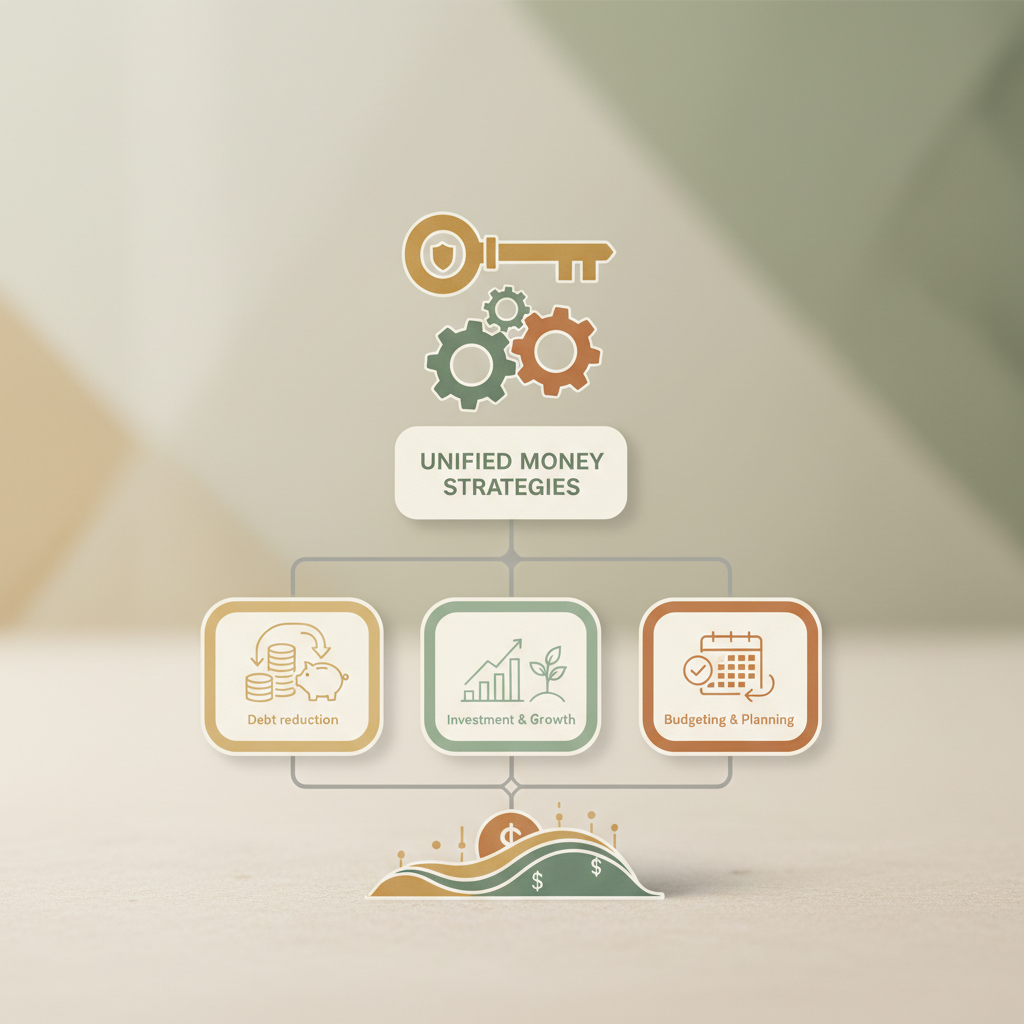
Treated as part of unified money strategies, it becomes a control layer that keeps the rest of the picture honest.
Financial stability seldom comes from paying one balance down faster.
It comes from knowing what you owe, why you owe it, and whether you can prove both.
Quick Answer: Debt management is essential in unified money strategies as it integrates the entire lifecycle of borrowed funds, from commitment to repayment, ensuring accuracy in cash flow, accounting, and payment authorization. A unified approach allows for a comprehensive view where all elements are recorded in one system, thus enhancing financial stability and reducing reconciliation challenges. Understanding not just what is owed, but the context and connections of each obligation is crucial for effective financial management.
What Debt Management Means in a Unified Financial Strategy
A distributor with a bank line, three supplier accounts, and remittance PDFs in email folders can usually say how much it owes.
But it cannot easily explain how those obligations relate to this month's cash, the general ledger, or the approvals for each payment.
This gap is where confusion about debt management often begins.
Debt management is the process of managing borrowed money from the moment you take it on until you pay it back.
It includes much more than just a repayment schedule.
The original obligation, the cash that funds it, the accounting records, and proof of authorized payments all belong to the same area of focus.
Traditional systems separate these pieces.
Debt is in a lender portal, cash flow is in a spreadsheet, and bookkeeping is in different software.
When the three never connect, reconciliation work increases and proving the repayment story becomes hard.
A unified money strategy brings them together.
The obligation is recorded once, the payment uses tracked cash, the accounting books update, and approvals link to the transaction.
The scope extends beyond repayment: personal obligations, business debts, repayment behavior, and supporting evidence share a single record.
This is important because debt decisions build up.
As the California Department of Financial Protection and Innovation states in its three-step guide to managing and getting out of debt, it's not just about how much you owe, but how you owe it.
Connected records answer that question faster, and they leave a trail you can eventually show a lender.
Why Debt Management Matters for Financial Stability
Repayment pressure rarely comes all at once.
It builds up—one week a supplier tightens their terms, another week a loan covenant resets, and a large receivable misses its due date.
Businesses that see debt management as a monthly chore miss the earlier signs completely.
As the One Percent Club's guide to debt strategies explains, debt management involves organizing, tracking, and systematically repaying what you owe to reduce interest costs and protect your credit.
This definition helps separate two layers teams often mix: the tracking layer, which shows what exists, and the repayment layer, which decides what happens next.
Cash flow issues happen before a borrower defaults.
Missed interest levels, penalties, and mismatched due dates quietly drain working capital, even when revenue looks good on paper.
Catching those issues early is cheaper than refinancing later.
| Management area | Fragmented approach | Unified approach | Potential decision benefit |
|---|---|---|---|
| Payment scheduling | Due dates tracked per system or inbox | Single calendar tied to cash position | Fewer missed or duplicated payments |
| Interest and fee visibility | Rates buried in statements and PDFs | Rates displayed alongside each obligation | Earlier payoff of the costliest balances |
| Approval records | Verbal sign-off, no stored evidence | Each commitment carries an approver and timestamp | Faster answers during review or dispute |
| Cash-flow forecasting | Obligations estimated manually | Liabilities netted against incoming cash | Realistic headroom before commitments |
| Credit-readiness evidence | Reconstructed from memory under pressure | Audit-style trail available on demand | Stronger position when approaching lenders |
Better records turn 'we owe a lot' into a clear number you can plan around.
Better records can help in credit talks without guaranteeing results, but clear, documented obligations eliminate a common reason for doubt.
Debt management is important for financial stability because it turns scattered obligations into a clear picture you can act on—before pressure leads to a crisis.
How Debt Management Works Inside a Unified Money Strategy
A debt is never isolated.
It connects to the bank balance that funds it, the ledger entry that records it, the approval that authorized it, and the evidence that confirms it occurred.
Separate them, and debt management becomes guesswork.
That is why a unified money strategy handles debt as connected data, not as a separate task.
The bank balance shows what is available to pay.
The ledger shows how the obligation changes over time.
The approval shows who allowed the commitment and under what conditions.
The evidence shows the transaction actually occurred.
When these elements sit in different systems or spreadsheets, reconciling them consumes attention and creates room for error.
When they stay connected, each payment updates the whole picture instead of forcing a manual rebuild.
Everything starts with a complete record.
Each obligation needs its balance, rate, repayment terms, responsible owner, and due date captured once, in one place.
That single record becomes the reference point for every later decision: whether to pay extra, refinance, pause, or prioritize another obligation.
Without it, the same questions return every month, and the answers depend on whoever last updated a file.
One Percent Club's guide to debt management strategies frames the discipline as a repeatable process: know what you owe, understand the terms, assign responsibility, and review the record as circumstances change.
Inside a unified money strategy, debt management is not a one-time cleanup.
It is the ongoing practice of keeping obligations visible, connected, and answerable to the same system that tracks the money used to repay them.
Debt Management Examples and Common Misconceptions
A mid-sized wholesaler with two equipment loans, a revolving line, and dozens of open supplier invoices kept records in a bank portal, an accounting file, and a folder of remittance PDFs.
Consolidating them into one reconciled view showed several invoices had already been settled and one loan’s rate had stepped up at renewal.
The amount owed did not change; the order of repayment did.
At household scale, a freelancer with uneven monthly income can line up repayment dates against the weeks invoices actually clear, protecting rent and utilities instead of paying a card early and borrowing back the difference.
Cross-border businesses face another wrinkle: separating the cost of debt from currency movement.
If a loan is in one currency and repaid with revenue in another, a weaker exchange rate can make your stable loan appear more costly.
Tracking the two separately keeps the borrowing decision honest.
Three assumptions get in the way.
Paying fastest is not always best — high-rate obligations usually deserve the first dollars, as the California Department of Financial Protection and Innovation's guidance on managing debt notes.
A complete financial record is not the same as a strong credit profile; lenders weigh repayment history, income, and reported data alongside it.
And no single dashboard replaces review, judgment, or professional advice.
Testing Whether a Debt Record Is Actually Reliable
| Question to ask | What a reliable record should show | Warning sign | Decision implication |
|---|---|---|---|
| Can the balance be reconciled? | Ledger balance matching the lender or supplier statement | Two different totals with no explanation | Stop new commitments until the gap is explained |
| Are rates and fees current? | Effective rate, stepped-up terms, and fees dated at last review | Rates unchanged since origination | Re-price the debt before ranking repayments |
| Is the repayment approved? | Named approver, date, and the authorization behind the payment | Payments made outside any approval step | Tighten controls before the next cycle |
| Is evidence attached? | Invoice, receipt, or confirmation linked to the entry | Proof stored in email threads or personal drives | Rebuild the trail before approaching a lender |
| Does the plan fit available cash? |
Practical Decisions, Limits, and Applications
Choosing a priority is the practical core of debt management.
Not every business needs to attack obligations the same way, and the right first move depends on which constraint is actually binding.
When cash is tight, affordability comes first because it protects the payment schedule.
When records are chaotic, visibility comes first — you cannot prioritize what you cannot see.
Cost reduction makes sense when rates are high and balances are stable across a full quarter.
Credit readiness matters
What are debt management strategies?
Debt management strategies refer to the systematic process of organizing, tracking, and repaying borrowed funds to minimize interest costs and maintain financial stability. It involves more than just making payments; it connects obligations to cash flow, accounting entries, and approval processes, offering a comprehensive view of financial health.
What are some effective strategies for managing debt?
Effective debt management strategies include consolidating obligations into a unified view to improve visibility and prioritize payments based on current cash flow. Businesses should also track repayment schedules, understand the impact of each debt on their financial position, and adjust strategies as conditions change.
How does debt management work?
Debt management works by treating debt as part of a unified financial strategy rather than a standalone task. It involves monitoring the connections between borrowed funds, repayment schedules, approval processes, and cash availability to ensure comprehensive financial control and informed decision-making.
What are the 5 C's of debt?
The 5 C's of debt typically refer to Character, Capacity, Capital, Conditions, and Collateral. These factors help lenders assess a borrower's creditworthiness and ability to repay loans, ensuring a thorough evaluation of the financial situation before extending credit.
What is the average net worth of a 65 year old couple?
The average net worth of a 65-year-old couple in the United States is approximately $1,794,600. This figure varies significantly based on factors such as location, income, and investment strategies, reflecting the diverse financial circumstances among households nearing retirement.
Where Debt Management Becomes a Control Layer
Think of debt management as more than just a repayment schedule; it's a control layer.
A payment that clears the bank on the 12th, lands in the ledger on the 15th, and reappears in the budget without an owner is three facts pretending to be one.
Close that gap and the numbers stop arguing with each other.
When a payment, its approval, and its evidence share one record, the same entries that reconcile your books also build the credibility lenders look for.
That is where unified money strategies earn their keep.
Trace one recurring debt payment this week from bank date to ledger date to approver.
If the three answers don't line up, you've found where financial stability quietly breaks — and where a connected system, ours included, starts to matter.
Sources
- Three Steps to Managing and Getting Out of Debt - DFPI (Accessed: October 5, 2026)
- What is Debt Management: Strategies & Tips (Accessed: October 5, 2026)
- What is Debt and Debt Management? Definition, How ... (Accessed: October 5, 2026)
- Effective Debt Management Strategies for 2026 (Accessed: October 5, 2026)
- Debt Management Strategies - MERS (Accessed: October 5, 2026)
- How to Create a Debt Management Plan (Accessed: October 5, 2026)
- Guide to Managing Debt: Understanding Good vs. Bad Debt (Accessed: October 5, 2026)
- Why a Debt Management Plan Is a Safer Way to Pay Off Debt (Accessed: October 5, 2026)