The Impact of Personal Finance on Business Money Management
By ScaleBlogger
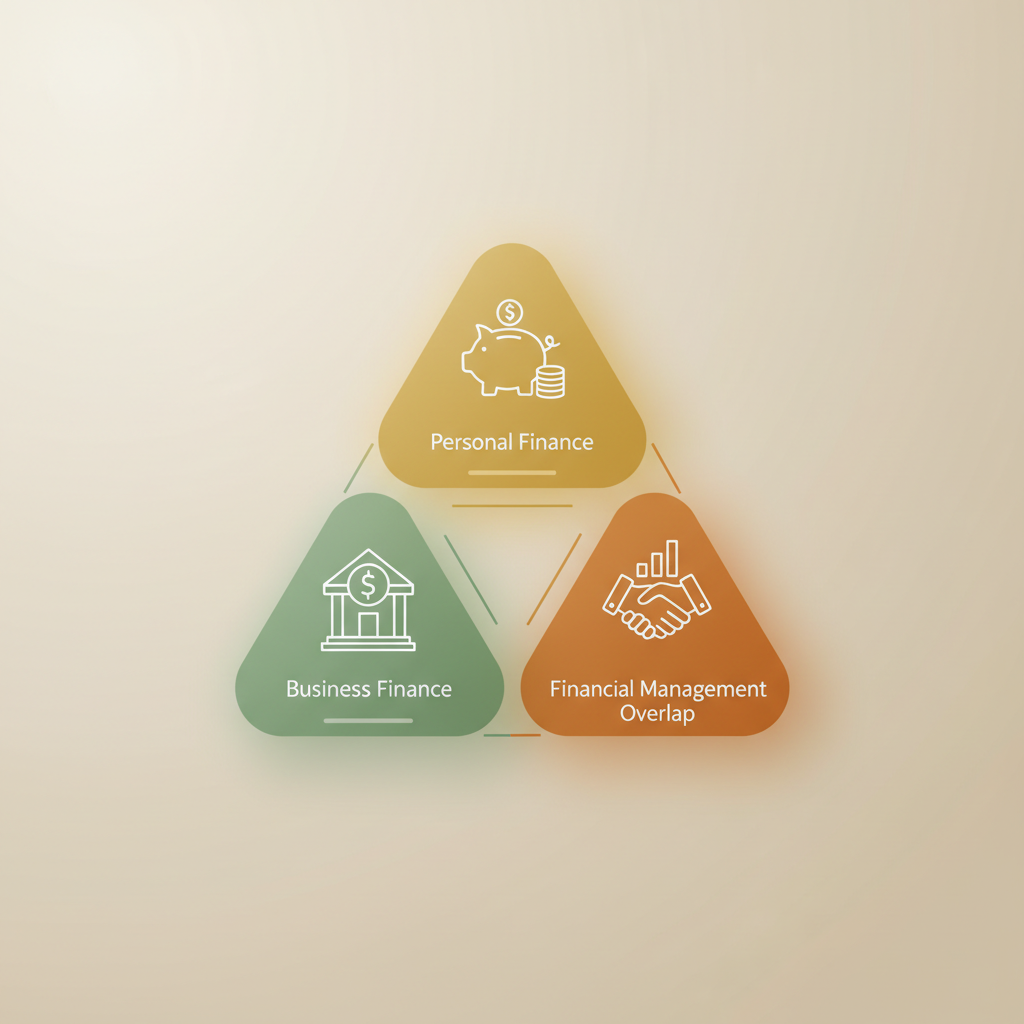
Unified Money Management For Individuals And Businesses, Personal Finance, Business Finance, Financial Management Overlap, Personal Finance In Business, Business Money Management, Personal Finance Vs Business Finance, How Personal Finance Habits Affect Business, Personal And Business Financial Management Overlap
A founder approves a $4,000 invoice on Friday. By Monday, they forget about it.
Three weeks later, the same person cannot explain a $40 grocery charge.
This gap is not a character flaw.
It is usually a problem with the system that starts at home.
Personal finance and business finance run on identical mechanics.
Money moves, a decision is made, records are kept, and books are checked against plans.
When these mechanics are missing in personal finances, they often do not appear in the company's finances.
Lenders and credit teams notice this pattern quickly.
They ask for approvals, receipts, and a record that holds up — and they read a business partly through how its owner handles money in general.
This overlap deserves more attention than it typically receives.
Financial management habits carry over. The controls you build for yourself often show up in how you run a growing business.
Quick Answer: Personal finance heavily influences how you manage business money. The financial habits you form at home often carry over into your business practices. Poor personal finance management can lead to systemic issues in a company's financial operations, as both domains share similar decision-making and record-keeping mechanics. Companies that effectively address overlaps between personal and business finance are better equipped to maintain financial discipline and transparency.
What Personal Finance Means in a Business Context
Personal finance is the management of an individual's money: the budget you keep, the bills you pay, the savings you build, and the debt you carry.
It operates in a closed system.
One person decides, and one person lives with the result.
Business finance operates on different terms.
It controls the money a company makes, spends, and keeps through payroll, supplier payments, inventory, and taxes.
Decisions involve many people, and every transaction needs to be recorded for verification by others.
The two domains share more mechanics than most owners expect.
According to a comparison of personal and business financial planning, both involve creating budgets, paying taxes, investing, and setting strategic goals.
The real split comes down to simplicity and complexity — an individual tracks a handful of accounts, while a company reconciles hundreds of entries across teams, currencies, and reporting periods.
That overlap is where practical confusion begins.
A founder who budgets carefully at home assumes the same instinct scales to the business.
It does not, not without structure.
This is why personal and business finances should connect through clear rules, not informal mixing.
Separate bank accounts keep personal finances intact regardless of how the business performs, as Old National's guidance on handling both notes.
The habits transfer cleanly.
The accounts should not.
Treating that boundary as a deliberate design choice — rather than something to sort out later — is what turns financial management overlap into an advantage instead of a liability.
Why Personal Finance Habits Matter to Business Money Management
With personal finance discipline, you rethink your approach to purchases. Rather than asking, 'Can we afford this?' you consider, 'Can we afford this in March?' This shift in perspective directly impacts your awareness of cash flow.
When an owner knows their weekly income and expenses, timing errors can show up before making decisions, like hiring without accounting for slow payroll periods.
Budgeting discipline cuts unnecessary costs. Checking recurring charges prevents overlapping software, unused licenses, and unnoticed renewals.
Personal financial pressure often leads to the opposite effect. It leads to delayed hires, defensive discounts, or late supplier payments. Old National’s guidance on separating personal and business finances notes that clear separation protects personal finances and keeps personal stress from steering business choices.
Matching Habits to Business Outcomes and Risks
| Personal finance habit | Possible business benefit | Business risk if applied incorrectly | Recommended control |
|---|---|---|---|
| Budgeting and planned spending | Realistic forecasts; discretionary spend reviewed before commitment | Rigid household budget ignores lumpy business cash cycles | Rebuild on rolling monthly forecasts |
| Emergency reserve | Absorbs a slow quarter without delaying payroll or suppliers | Reserve spent as working capital | Hold in separate account with draw-down threshold |
| Reviewing recurring payments | Removes duplicate tools, dormant licences, auto-renewals | Personal subscriptions from business accounts blur records | Route recurring charges through one business account; review quarterly |
| Tracking income and expenses | Faster month-end close; cleaner bookkeeping | Informal tracking without receipts fails audit or credit review | Record each transaction with approval and evidence |
| Using personal funds for business costs | Short-term liquidity when supplier payment cannot wait | Mixed funds break double-entry accuracy and complicate ownership and tax records | Log transfer as documented loan or capital contribution with repayment date |
Applying it to business money without documentation is.
Paying a supplier with a personal card and recording it as a business expense creates a real, unverifiable liability.
Recording it as a documented loan preserves the cash-flow benefit and keeps the books clean.
Budgeting and cash-flow awareness transfer cleanly; fund mixing does not, unless each action carries a record.
How Personal and Business Financial Management Overlap
The overlap is real, but it exists in practices, not in shared cash.
Both areas operate on the same framework: money comes in, money goes out, and someone needs to explain the difference.
What changes
Examples and Misconceptions About Personal Finance and Business Finance
A growing company can embrace the discipline of personal budgeting without mimicking its exact structure.
Tracking expenses for the next thirty days improves cash-flow planning more than a detailed annual budget that no one reviews.
The common threads—budgets, tax obligations, strategic goals—carry over almost unchanged, as an analysis of personal and business financial planning notes.
The difference between them is in scale and complexity, not in method.
One misunderstanding is that having separate accounts is sufficient on its own.
If a founder pays a supplier from a personal card and reimburses themselves, they haven’t just used the “wrong bucket”—they’ve created a reconciliation problem the bank statement cannot explain.
Without an expense note and recorded approval, the payment looks like an owner draw, and the books lose track of what the business actually bought.
Untangling one mixed transaction at year-end can take an afternoon, because you’re rebuilding context after the fact rather than capturing it while the transaction is still fresh.
Another misconception is that separation means ignoring the owner's role.
In practice, separation clarifies it.
Lenders and tax obligations are easier to satisfy when business results aren’t blurred by personal spending or reimbursements.
Think of it like labeling jars: the owner’s funds still exist in the system, but transactions stay traceable to the right purpose, so the financial picture can be read consistently, not guessed later.
Practical Applications, Limits, and Financial Management Decisions
Personal finance habits give you instincts, while business controls provide the proof.
The goal is to transform one into the other. Set aside reserves like personal savings and keep clear records of all company money movements. This allows an accountant, lender, or future buyer to understand without needing explanations.
A Control Checklist for Business Money Movement
| Management area | Control to establish | Evidence to retain | Business outcome |
|---|---|---|---|
| Budgeting | Maintain a rolling 90-day operating budget with a reserve equal to two to three months of fixed costs | Approved budget version, date, and named owner | Fewer mid-quarter surprises; hiring timed to cash |
| Expense approvals | Require a named approver above a set threshold, such as 1,000 in your reporting currency | Approval timestamp, requester, approver, and stated purpose | Spending traceable to a person rather than a habit |
| Account separation | Keep business and personal bank accounts and cards distinct, with owner draws recorded as formal entries | Statements, transfer references, and a signed draw or loan agreement | Cleaner books and a defensible personal balance sheet |
| Bookkeeping | Post every transaction through double-entry ledgers with a monthly close | Journal entries, reconciliations, and supporting receipts | Statements you can hand to a lender without rework |
| Foreign exchange | Apply one benchmark rate across payables, expenses, and ledger entries | Rate source, timestamp, and the conversion applied | Comparable margins across months and currencies |
| Credit documentation | Assemble revenue, receivables, and repayment history before applying | Filed statements, contracts, and evidence of on-time payments | A shorter, better-evidenced credit conversation |
That combination turns tidy habits into something a bank or investor can verify
What are the key differences between personal finance and business finance?
The key differences between personal finance and business finance lie in scale and complexity. Personal finance manages an individual's money through budgeting and debt management, while business finance oversees company revenues, expenditures, and payroll with decisions involving multiple stakeholders and extensive documentation.
What are the 5 basics of personal finance?
The five basics of personal finance typically include budgeting, saving, investing, debt management, and understanding financial education. Effective budgeting ensures expenses do not exceed income, while saving builds a financial cushion. Investing grows wealth over time, debt management minimizes costs, and financial education equips individuals with the knowledge to make informed decisions.
What are the key differences between corporate finance and personal finance?
Corporate finance and personal finance differ mainly in their scope and purposes. Corporate finance focuses on strategic financial management for businesses, including investment decisions and capital structuring, while personal finance deals with individual financial health, addressing budgeting, savings, and debt management on a personal level.
What is the difference between finance and personal finance?
Finance is a broad term that encompasses the management of money, including corporate finance, public finance, and personal finance. Personal finance specifically refers to the financial management practiced by individuals or households, emphasizing budgeting, savings, and planning for future financial needs.
What is the 7 7 7 rule for money?
The 7 7 7 rule for money suggests that individuals should allocate their income into three broad categories: save 7% for emergencies, invest 7% for future growth, and spend only 7% on discretionary expenses. This simple framework aims to promote financial discipline and encourage smarter financial decision-making.
The Same Discipline, Two Ledgers
The founder who can't explain a $40 grocery charge and the one who can't explain a $4,000 invoice both lack the same control.
That's the overlap worth remembering: personal finance habits and business finance discipline are one skill set, not two.
It's the habit of providing evidence for money movements.
That’s why the solution is often simpler than most owners realize.
You don't need a new budgeting method or a full accounting change. You just need to answer one question every time: Can I prove why this payment was made?
Pick one recurring payment this week and attach its approval or receipt before you send it. Our approvals and evidence tracking is built for exactly that, and the habit scales from groceries to vendor invoices.
Sources
- The Difference Between Your Personal and Business ... (Accessed: October 5, 2026)
- Business Finance vs Personal Finance Explained (With ... (Accessed: October 5, 2026)
- Personal vs. Business Finances: How Business Owners ... (Accessed: October 5, 2026)
- Business vs Finance Degree: What Are the Key Differences? (Accessed: October 5, 2026)
- Corporate Finance vs. Personal Finance: Key Differences ... (Accessed: October 5, 2026)
- Managing Personal and Business Finances the Smart Way (Accessed: October 5, 2026)
- What is the difference between business finance and ... (Accessed: October 5, 2026)
- The Similarities Between Personal And Business Financial ... (Accessed: October 5, 2026)