What Is AI-Powered Bookkeeping? How Automated Categorization Actually Works — and Why It Still Needs Evidence
By ScaleBlogger
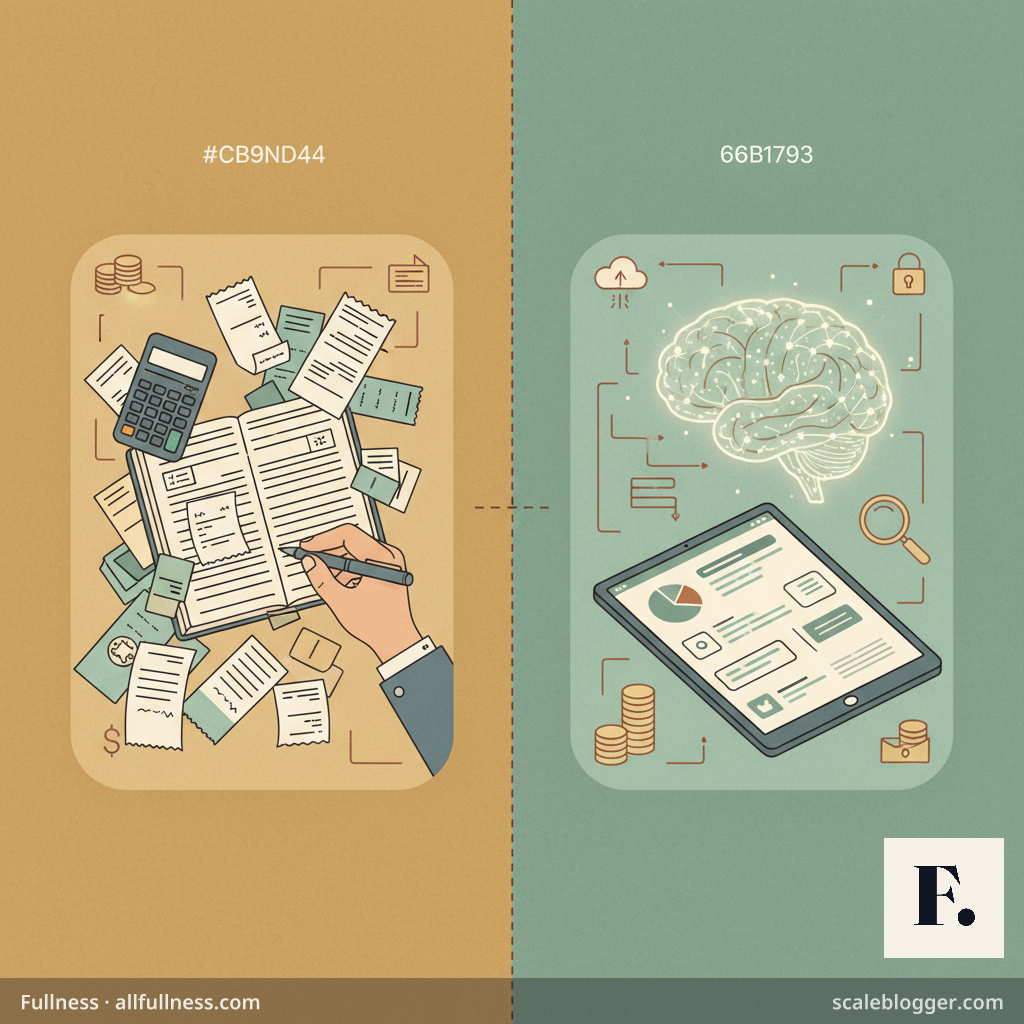
A bank feed might list “Amazon,” an amount, and a date. But this does not tell us if it was for supplies, equipment, or personal use. The transaction has details but no business context to decide how to record it.
AI bookkeeping uses machine learning, language processing, and document reading to categorize transactions. It suggests categories, matches receipts, aids reconciliations, and flags unusual entries. By transforming raw financial data into proposed accounting entries, it accelerates bookkeeping.
Automated transaction categorization begins with importing data from banks. The system analyzes the payee, description, amount, date, and account history, comparing these against rules, known vendors, keywords, past records, and the chart of accounts.
This generates recommendations but never a definitive classification. For example, a recurring software payment could be a setup fee, and a bank transfer might represent a loan, an owner’s contribution, or a transfer between accounts.
A confidence score indicates how closely a transaction matches past patterns but doesn't confirm the business purpose, validate the charge, or verify the existence of a source document.
Responsible AI bookkeeping treats these suggestions as guides requiring evidence and human review. Without a receipt, approval, or explanation, the category remains an informed guess.
Quick Answer: AI-powered bookkeeping automates transaction categorization, receipt extraction, and reconciliation using machine learning, natural language processing, and OCR. Leading systems achieve 95-99% accuracy, yet human review remains essential to confirm business purpose and finalize records. AI functions as a drafting tool, not as an autonomous ledger writer.
What Is AI Bookkeeping? Definition, Scope, and Boundaries
AI bookkeeping uses machine learning, language understanding, scanned documents, and automation. It records, sorts, matches, and organizes financial transactions.
The process usually begins with bank data or source documents. Pattern matching compares date, amount, payee, and description with known transactions and accounting rules.
Vendor memory uses past approved treatments for known merchants. Confidence scores decide if recommendations are automatic or need review.
Exception flags mark unclear transactions, like an Amazon charge that could be supplies, equipment, or personal spending.
AI-powered bookkeeping can automate several tasks: it suggests ledger accounts through pattern recognition; extracts merchant, date, amount, and text from receipts and invoices; identifies recurring vendor payments; matches transactions for reconciliation; converts multi-currency amounts; and routes uncertain items for review and approval. Despite this automation, each step demands human validation to confirm the business purpose, verify document completeness, and approve exceptions. The system produces draft classifications and records designed for review rather than final posting without oversight.
A confidence score shows similarity, not truth. For example, a bank transfer might look like a payment between accounts but could be an owner contribution or loan.
A double-entry record posts equal debits and credits to keep the ledger balanced. It is reliable only if linked to source evidence and clear decisions.
The AI for Bookkeeping in 2026 guide shows a responsible process: source document, AI draft, review of exceptions, human approval, and recorded entry.
At Fullness, AI helps sort data. Evidence, approvals, and official ledgers support financial decisions.
AI can reduce repetitive data entry but cannot explain why a transaction occurred.
Why Categorization Quality Matters to Solopreneurs and Small Businesses
Imagine a lender seeing a $1,240 transaction labeled “software.” The label seems fine, but the business has no invoice, no explanation, and can't prove if it was for setup or a subscription.
The category could be correct, but the record is weak.
This gap causes real problems.
A reviewer might ask questions, delay decisions, or skip the expense until it is confirmed.
This uncertainty can also cause problems during tax audits, cash-flow planning, partner reports, and profit discussions.
AI bookkeeping fundamentally relies on inference. It analyzes the payee, description, amount, date, currency, and past transactions using pattern matching against known transaction types and the chart of accounts. The system retains a vendor memory, recalling how previous payments to a vendor were classified, which improves future suggestions but does not guarantee consistent purposes.
It assigns a confidence score that reflects similarity to past cases. A high score triggers automatic routing or prioritization for review but doesn't confirm business intent. When the score falls below a threshold or conflicts arise, the system flags the transaction for human review. Responsible systems integrate automated suggestions with exception handling and require human oversight.
Mixed-use vendors complicate this further: a single merchant can supply business equipment, household goods, or personal items. Transfers also introduce ambiguity, as one payment could represent an owner contribution, a loan movement, or inter-account transfer.
Foreign-currency transactions add exchange-rate and conversion questions before anyone can assess the underlying category.
A confidence score answers, “How familiar does this look?” Proof answers, “Can someone explain and support this decision?” Those are different questions.
The evidence layer should retain the source document, reviewer decision, approval history, and final double-entry record—a balanced journal entry where total debits equal total credits.
Our double-entry bookkeeping approach keeps AI-assisted sorting separate from the authoritative ledger, while traceable journal entries connect reports back to source transactions.
Good categorization saves review time.
Good evidence makes the resulting record understandable, defensible, and useful when cash decisions or credit conversations become consequential.
How Automated Transaction Categorization Actually Works
A lender reviewing a hypothetical $680 charge sees “software” in the ledger, but the business has no invoice, approval, or explanation.
That gap shows what AI bookkeeping is: a system that infers a likely treatment from available data, not one that proves a transaction’s purpose.
What is AI bookkeeping doing behind the category?
Automated transaction categorization follows a pipeline: it imports bank data, compares patterns, proposes an account, scores confidence, and routes uncertain items for review.
This workflow is consistent with the AI bookkeeping workflow described by Coursiv.
The system ingests the description, amount, date, source account, payment channel, and attached receipt or invoice.
It uses pattern matching to compare those details with known words, merchants, amounts, account types, and prior decisions.
A payment marked “Microsoft” might indicate software, cloud hosting, or a one-time service. Vendor memory captures how the business classified that vendor before, while historical behavior adds context from approved entries.
The system suggests a category and assigns a confidence threshold, the minimum score for automatic routing.
A high score may send the item toward approval; a low score creates an exception flag for human review.
Confidence reflects similarity to known patterns, not proof of business purpose.
How the inference pipeline controls risk
| Processing stage | System signal | Typical output | Primary risk | Required control |
|---|---|---|---|---|
| Data ingestion | Description, amount, date, account, attachment | Normalized transaction | Missing or altered source data | Preserve the original record |
| Pattern matching | Merchant, keywords, channel, amount | Candidate categories | Misread description | Compare multiple fields |
| Vendor recognition | Known payee and prior postings | Vendor-based suggestion | New or shared vendor | Confirm vendor identity |
| Confidence scoring | Match strength and historical consistency | Confidence score | False certainty | Set review thresholds |
| Exception handling | Ambiguous, unusual, or incomplete data | Review queue | Important items bypass review | Require human resolution |
| Approval and posting | Approved category and evidence | Controlled accounting entry | Unsupported classification | Retain approval and source documents |
A transfer may be an owner contribution, loan movement, or payment between accounts.
A refund may reverse an expense rather than create income, and a foreign-currency charge may require consistent conversion evidence.
After approval, the category should become a controlled double-entry record, where equal debits and credits preserve the ledger’s balance.
Evidence and approval remain attached to the transaction, while the AI stays outside authoritative financial tables.
Reports can then trace to the underlying journal entries and source transactions.
New vendors, mixed purchases, unusual amounts, transfers, and refunds expose pattern-based limits.
AI sorts possibilities efficiently; retained evidence and accountable approval make the record defensible.
Examples, Failure Modes, and Common Misconceptions
A lender sees a hypothetical $2,400 software charge categorized correctly, but the business cannot produce an invoice, approval, or explanation of what it purchased.
That illustrates what is AI bookkeeping: inference and sorting, not proof that a transaction belongs in business records.
When evidence is missing, a confidence score only measures similarity to known patterns; it does not establish business purpose, ownership, approval, or correct accounting treatment. Responsible workflows route uncertain transactions for human review rather than treating AI suggestions as final. For example, a personal purchase on a business card may appear identical to an office expense by merchant, amount, and description. The model might confidently categorize it but miss the lack of business benefit.
An uploaded receipt confirms the purchase occurred but doesn't prove who approved it, who owns the item, or how it should be expensed. Evidence informs decisions; it doesn’t replace them.
Where automated transaction categorization fails
| Scenario | Likely automated suggestion | Why the suggestion may be wrong or incomplete | Evidence needed | Human decision |
|---|---|---|---|---|
| Recurring software charge | Software expense | Subscription may include implementation or prepaid service | Invoice, contract, approval | Expense, prepaid cost, or another treatment |
| Mixed-use purchase | Office expense | Business card purchase may include personal items | Itemized receipt, business purpose | Split, reimburse, or reclassify |
| Bank transfer | Income or expense | Transfer may be between accounts, an owner contribution, or loan movement | Bank statements, transfer purpose | Record transfer, financing, or business activity |
| Refund or reversal | Reduced expense | Credit may reverse a prior period, or belong to another transaction | Original receipt and refund notice | Match, reverse, or investigate |
| Foreign-currency expense | Correct expense category | Conversion date, rate, fees, or settlement value may be missing | Original currency receipt, rate, fees | Record currency conversion and related difference |
A category can be right while the record remains incomplete, especially for transfers and foreign-currency activity.
The misconception that automation equals learning
It is also wrong to assume every correction permanently improves the model.
Feedback must be captured, validated, and applied; otherwise ambiguous patterns can recur.
Human review remains necessary because automated bookkeeping can surface what is present but cannot supply missing context.
A defensible record connects the suggestion to source evidence, approval, and a balanced double-entry record.
That keeps AI-powered bookkeeping useful without confusing probability with proof.
Using AI Bookkeeping Safely: Evidence, Controls, and Buying Decisions
A hypothetical lender reviews a $1,860 foreign-currency charge marked “marketing,” but the business cannot produce the invoice, approval, or exchange-rate basis behind it. What is AI bookkeeping here? It is an inference process proposing a likely treatment, not proof that the treatment is correct.
What is AI bookkeeping safe enough to accept?
The system reads transaction data such as the payee, amount, date, currency, and description.
Through pattern matching, it compares those details with prior transactions, chart-of-accounts rules, and vendor behavior. Vendor memory means it remembers that a merchant was previously posted to a specific account.
It produces a category and confidence score.
A confidence threshold determines whether software accepts a suggestion automatically, sends it for review, or marks it as an exception.
The score measures similarity to earlier patterns; it does not prove the purchase’s business purpose, tax treatment, approval, or ownership.
A mixed foreign-currency charge should remain reviewable.
The reviewer may need the supplier invoice, payment statement, conversion basis, internal note, and approval history before accepting the category.
As AI bookkeeping workflow guidance from Coursiv explains, responsible processes separate source capture, draft categorization, exception review, and final recording.
The evidence layer preserves those facts beside the transaction.
It may include receipts, invoices, bank statements, explanations, approval records, and a direct link to the source transaction.
The control layer determines who reviews unusual amounts, who approves them, and whether the system keeps an audit trail of changes.
At Fullness, our operating model keeps AI in the sorting layer: AI suggests, a human approves, and the canonical double-entry record retains supporting proof.
A double-entry record records equal debit and credit entries, creating a balanced accounting history rather than a separate AI-owned set of books.
Reports can trace back to underlying journal entries and source transactions.
Before choosing software, ask whether it preserves original documents, supports review thresholds, separates preparation from approval, routes exceptions, and records corrections.
Also ask whether users can explain a posted transaction months later, including transfers, refunds, mixed spending, and currency conversion.
Accept automation when the source is clear, the pattern is stable, the amount is routine, and evidence is attached.
Correct it when the category is plausible but incomplete.
Escalate it when ownership, purpose, currency treatment, or approval remains uncertain.
A fast suggestion becomes valuable only when the record can withstand informed review.
Is bookkeeping going away with AI?
Bookkeeping is not going away with AI; instead, AI acts as a drafting tool that automates transaction categorization and reconciliation but still requires human review. AI bookkeeping recommendations generally require manual approval to verify business purpose and accuracy before finalizing records, but the exact percentage is not specified.
What are people replacing QuickBooks with?
The content does not specify alternatives to QuickBooks. However, AI-powered bookkeeping tools that use machine learning, natural language processing, and OCR to automate categorization and reconciliation are increasingly integrated with or used alongside traditional software.
How can I use AI to do my bookkeeping?
You can use AI bookkeeping by importing bank and transaction data into an AI-powered system that applies pattern matching, vendor memory, and confidence scoring to suggest categorization and reconciliation. Still, you must review flagged or uncertain transactions to provide evidence and approval.
Is AI bookkeeping any good?
AI bookkeeping effectively speeds up categorization and reconciliation by inferring likely transaction treatments using historical patterns, but it cannot replace human validation. It provides probable categorizations, yet studies suggest that most recommendations still require manual review to ensure accuracy and proper evidence.
Can QuickBooks automatically categorize transactions?
QuickBooks and similar AI bookkeeping systems can automatically categorize transactions by reading payee, amount, date, and history, then comparing them to rules and past patterns. However, automatic categorizations often require human review to confirm business context and validity.
Treat AI Bookkeeping as an Inference, Not a Verdict
AI bookkeeping provides probable transaction categorizations based on patterns and historical data but does not replace evidence or human judgment.
Confidence scores reflect resemblance to prior cases, not verified business purpose.
This distinction is critical: the same merchant can represent different expense types under similar labels.
The clearest responsible model combines AI sorting, human approval, and evidence-backed double-entry records.
Without this layered approach, speed can lead to confident yet incorrect decisions.
Practical tip: Review recent transactions regularly, verify uncertain categories with available documentation, and establish rules to route ambiguous items for review.
Strong bookkeeping systems prioritize verifiability over guesswork, making each category easy to substantiate when it matters most.
Sources
- For those who do bookkeeping / monthly reports - how do you auto-categorize Stripe, Shopify, Square, bank transactions? Question for people handling bookkeeping (Accessed: October 30, 2026)
- I was struggling to understand anything until I used AI I’m sure many people are against using AI to gain knowledge on things such as Accounting, but I have bee (Accessed: October 30, 2026)
- Bookkeeping and Accounting I easily built a localized agent in Claude CODE that handles all of my QBO bookkeeping, bank reconciliation, and other accounting res (Accessed: October 30, 2026)
- Is BooksGPT a QBO Alternative? Small business owner here. I am still on QB desktop and do not want to switch to QBO. Has anybody tried BooksGPT? (Accessed: October 30, 2026)
- I waited years for YNAB to automate categorisation. Today I stopped waiting. I’ve spent years wanting YNAB to take more of the manual categorisation off my hand (Accessed: October 30, 2026)
- AI for Bookkeeping in 2026: A Practical Workflow Guide (Accessed: October 30, 2026)
- Everything You Need to Know About AI Bookkeeping in 2026 (Accessed: October 30, 2026)
- AI Bookkeeping: Complete 2026 Guide to Automated ... (Accessed: October 30, 2026)
- Best AI Bookkeeping Tools for Finance Ops in 2026 (Accessed: October 30, 2026)
- Guide to AI in accounting: Trends, tools, and stats (Accessed: October 30, 2026)
- Xero (Accessed: October 30, 2026)
- QuickBooks Online (Accessed: October 30, 2026)
- Booke AI (Accessed: October 30, 2026)
- Fullness (Accessed: October 30, 2026)
- Mercury (Accessed: October 30, 2026)