Understanding Cash Flow Management: A Key Component of Unified Money Management
By ScaleBlogger
Unified Money Management For Individuals And Businesses, Cash Flow Management, Money Management Strategies, Financial Health
A profitable quarter doesn’t matter if the bank balance is low.
Many growing businesses show good numbers on paper but still struggle to pay their employees on Friday.
That gap between reported profit and real money movement is where cash flow management lives.
It involves tracking when money comes in, when it goes out, and if they match up each day.
Most owners view it as forecasting, estimating next month’s balance and hoping it’s accurate.
That narrow view explains why so many money management strategies stall: they watch the number instead of the system that produces it.
Cash flow also depends on who approved each payment, what proof exists, and how these movements are recorded.
Miss one link, and your financial health looks solid right up until it isn't.
Quick Answer: Cash flow management is the practice of tracking and controlling the timing of money entering and leaving a business, ensuring that actual cash movement aligns with reported profits. It is essential for maintaining financial health, as a company can be profitable yet still face cash shortages, particularly when payment cycles and cash inflow do not match. Effective cash flow management involves forecasting needs and timing payments to avoid liquidity issues.
What Cash Flow Management Means
A distributor finishes the quarter with a good profit margin.
Two weeks later, a supplier’s bill is due, but the bank account is low. The invoice that created the profit is still unpaid and is ninety days overdue.
That gap is exactly what cash flow management exists to close.
Cash flow management focuses on timing — tracking when money flows in and out, not merely the amounts at stake.
It is different from accounting, which only records past events.
It is also different from budgeting, which plans for future spending.
It is different from profit, which is revenue minus costs over time.
A company can be profitable and still run out of cash.
For growing businesses, this situation can change fast.
Every sales cycle, supplier deal, payroll date, and currency change is part of one connected system.
As NetSuite's guide to cash flow management explains, the work involves forecasting cash needs, timing payments, and controlling expenses together rather than in isolation.
The first step is to track movement.
Understanding the quality and timing of that movement helps keep a profitable business afloat.
Understanding Why Cash Flow Management is Critical for Your Financial Health
A profitable year on paper doesn't mean there is enough money for Tuesday's payroll.
Profit is an accounting term that means money earned minus costs. Cash is the money received and paid on a specific day.
This gap can lead to short-term cash problems. For example, a business might make a big sale in March, pay its suppliers and employees in April, and then receive the payment in July.
Managing cash flow is more important for financial health than any one balance.
According to J.P. Morgan's guide to cash flow management and reporting, understanding trends in cash inflows — like sales revenue, investments, and financing — helps a business use that information effectively.
How Control Changes the Numbers
| Business condition | Unmanaged cash flow | Controlled cash flow | Business benefit |
|---|---|---|---|
| Incoming customer payments | Invoices raised in one system, due dates tracked loosely | Invoice tied to the same record as the sale, aging visible daily | Faster collection, fewer missed follow-ups |
| Supplier and operating expenses | Bills paid when they surface, sometimes early, sometimes late | Payment timing planned against expected inflows | Working capital preserved, fewer late fees |
| Approval and supporting evidence | Approvals given by email or verbally, evidence stored separately | Approver, timestamp, and supporting documents attached to the action | Defensible audit trail on demand |
| Accounting records | Books reconciled monthly, discrepancies found weeks later | Double-entry entries updated as activity happens | Accurate reporting for the current period |
| Credit or funding review | Applicant presents bank statements and projections | Applicant presents transaction-level records with documented controls | Stronger footing in underwriting conversations |
How Cash Flow Management Works
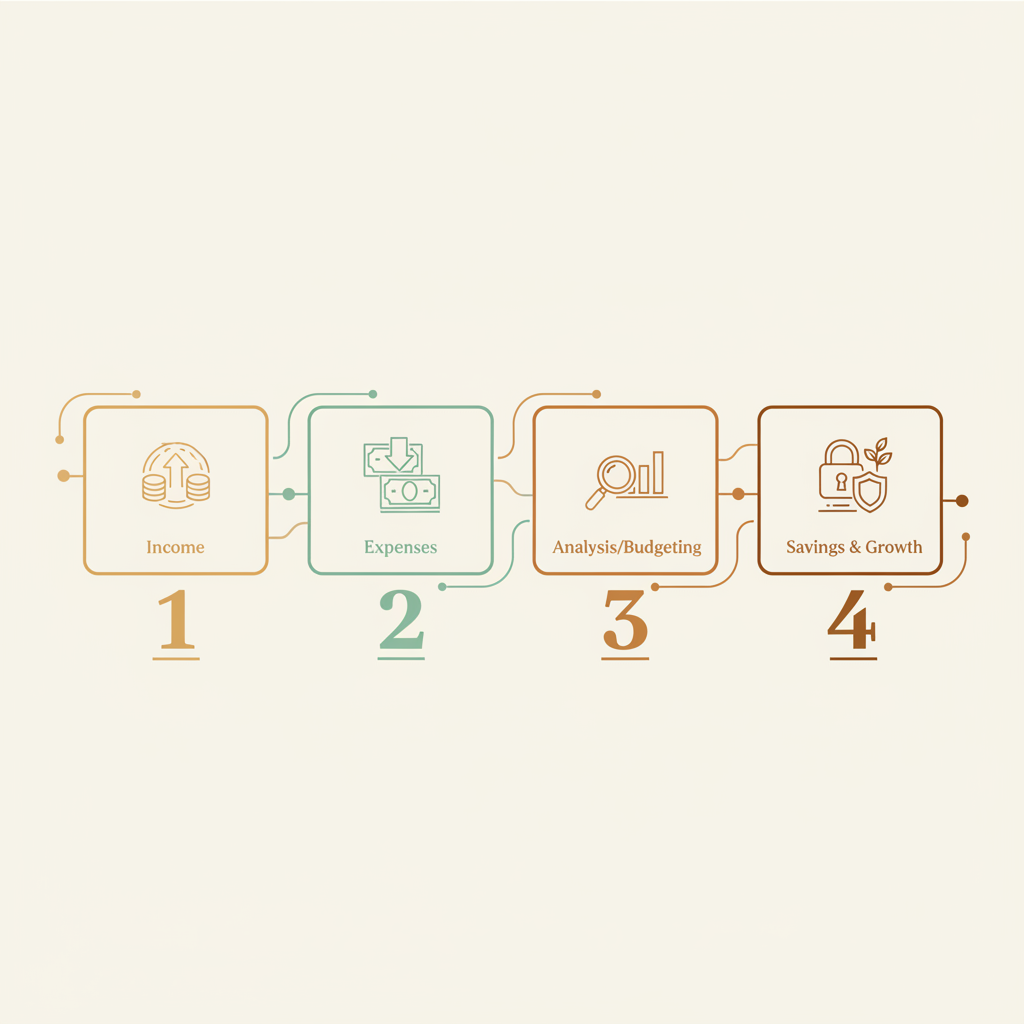
Cash flow management works like a loop. First, capture what comes in and out. Next, forecast when it will arrive, control what goes out, and record everything to ensure the numbers match.
The loop begins with a full view of money coming in and going out.
Sales revenue, supplier bills, payroll, and financing are all tracked on one timeline.
As noted in J.P. Morgan's cash flow management and reporting guide, understanding trends in inflows and outflows turns raw data into actionable signals.
Next is forecasting timing.
A balance shows what you have now, while a forecast shows what next month will look like. NetSuite's overview of cash flow management describes this work as proactive. It involves forecasting needs, timing payments, and managing expenses together.
Control involves getting approvals and keeping evidence.
When a payment over a certain amount needs a documented approval, it creates a record of the decision.
Spending is no longer hidden.
Recording keeps the loop accurate.
Double-entry bookkeeping requires each transaction to be recorded in at least two accounts. This catches any entry that doesn't balance right away.
Currency adds an important aspect.
If a business pays a supplier in euros but invoices in dollars, the exchange rate affects the actual cost.
Tracking that rate consistently — across payment, expense, and ledger — keeps reported margins from drifting away from actual cash.
Together these steps turn cash flow management from a monthly guess into a repeatable operating routine.
Cash Flow Management in Practice
A routine is only proven by real invoices.
Imagine a mid-sized equipment supplier whose biggest customer pays in 75 days, not the agreed 45.
The work begins before the due date. Someone checks the aging report each week, marks the account, and decides whether to use a credit line or delay a purchase.
If you wait until cash is needed, you lose all options except the costly one.
Supplier spending becomes more complex when vendors bill in different currencies.
If a euro invoice is approved at one rate and paid at another, the purchase cost changes.
Capturing the conversion at the approval moment, not at month-end, links the expense to the decision that caused it.
Turning Activity Into a Record Lenders Can Read
| Cash flow event | Information to capture | Control or action | Decision supported |
|---|---|---|---|
| Customer invoice issued | Invoice number, due date, customer terms, expected settlement date | Approval of credit terms and a scheduled follow-up before the due date | Whether to extend terms to that customer again |
| Customer payment delayed | Days past due, reason given, revised collection date | Escalation to a named owner and a hold on new orders if needed | Whether to draw on a credit line or tighten collections |
| Supplier bill approved | Vendor, amount, currency, approval name, purchase reference | Two-person approval above a defined threshold | Whether the spend is committed and when it leaves the account |
| Foreign-currency conversion completed | Rate applied, timestamp, source currency, ledger entry | Same reference rate used across payment, expense, and books | How to report the true cost of the purchase |
| Month-end reconciliation | Bank balance, ledger balance, unmatched items, variance notes | Sign-off only when the two balances agree | Whether the reported position can be relied on for planning |
When lenders ask about late payments or cross-currency purchases, the answer is a documented sequence rather than a recollection.
Forecasting is one output; timing, approvals, and reconciliation make it trustworthy.
Working through these events once makes the next cycle faster.
Practical Money Management Strategies and Limits
The difference between a useful forecast and one that simply fills a spreadsheet is timing.
A rolling forecast should be updated based on actual payment behavior, not just contract due dates.
The customer who pays on day 75 is more important than the invoice that states day 45.
According to Truist's ten strategies for effective cash flow management, maintaining working capital discipline is crucial.
Separating transactions into expected, committed, and completed changes what the number actually means.
Expected cash is a probability, committed cash is a decision already made, and completed cash is a fact recorded in the ledger.
Blending all three produces a forecast that flatters the balance.
Approval controls should scale with the decision they govern.
A routine supply order needs a quick check; a new vendor contract or a large cross-currency payment deserves documented review and evidence of who signed off.
Cash flow figures also need company.
Read them beside receivables aging, debt covenants, and margin trends rather than in isolation.
What cash flow management cannot do matters just as much.
It will not rescue an unprofitable product line or a customer base that simply cannot pay.
It organizes the timing of money you already have a right to collect — nothing more.
Choosing a Unified Approach to Cash Flow Management
Most businesses don’t lack financial data.
They lack data that arrives complete, current, and traceable—three tests that separate a record you can act on from one you merely store.
Completeness means every inflow and outflow is in the same ledger, even activities not in the main operating account.
Currency means the numbers show current conditions, not a past snapshot.
Traceability means any figure can be traced back to the transaction, the approval, and the supporting document.
Apply those tests and a second question appears: do the controls actually connect? Tracking a payment in one system, approving it in an email, and manually posting it in the books creates several versions of a single event.
JPMorgan's cash flow management and reporting guide describes the discipline as understanding trends and patterns around inflows and outflows—harder when those patterns live in separate places.
Currency also introduces a quiet failure mode.
Record a EUR invoice at one rate, pay it at another, then reconcile it in the ledger at a third, and the variance falls outside anyone’s forecast.
Using a consistent benchmark rate, applied hourly across payments, expenses, and entries, helps keep reported margin aligned with actual movement.
Records earn their keep when they answer a specific question: can we cover the supplier bill on the 14th, and can we show a lender how that decision was reached?
What are some effective strategies for managing cash flow?
Effective cash flow management strategies include closely tracking money movement, understanding payment cycles, and conducting regular forecasts. Businesses should prioritize invoices and payments based on actual cash availability rather than contractual due dates, ensuring that anticipated cash inflows align with outflows.
What are five rules of cash flow?
Five rules of cash flow include: 1) Track every inflow and outflow comprehensively. 2) Forecast using real payment behavior. 3) Prioritize timely collections to reduce lag.
4) Separate transactions into expected, committed, and completed categories. 5) Keep a rolling forecast to continuously adapt to changes.
What is the definition of cash flow management?
Cash flow management is the practice of monitoring and controlling when money enters and leaves a business to ensure that actual cash movement aligns with reported profits. It is essential for maintaining liquidity, as businesses can be profitable yet face cash shortages due to timing mismatches.
What are five ways to improve my cash flow?
To improve your cash flow, automate invoicing to speed up payments, conduct regular forecasts, negotiate better terms with suppliers, cut unnecessary expenses, and keep a line of credit ready for emergencies. These strategies help ensure that cash inflows are timely and predictable.
What are the big three of cash management?
The big three of cash management are cash flow forecasting, cash flow analysis, and cash flow control. These components work together to provide a comprehensive view of a company's cash position, helping businesses anticipate needs, manage expenditures effectively, and ensure sufficient liquidity.
Focus on the System, Not Just the Snapshot
Balance alone tells you where you stand today.
The key to cash flow management is the chain underneath—approvals, evidence, and double-entry records that explain money movements.
That's the shift worth making.
The business that feared payroll on a Friday isn't rescued by a healthier-looking spreadsheet; it's rescued by knowing which invoices cleared, which approvals were still pending, and what the books actually say.
Trace one recurring payment end to end this week — approval, evidence, ledger entry, currency rate.
If the trail breaks, that's where to start fixing things.
Creating that connected record is what our platform is built for, but asking the right questions helps it stick.
Sources
- Cash Flow Management & Reporting Guide for Businesses (Accessed: October 6, 2026)
- 10 Strategies for Effective Cash Flow Management (Accessed: October 6, 2026)
- Six Ways to Strengthen Your Cash Flow Management ... (Accessed: October 6, 2026)
- Cash Flow Management: Definition, Importance, and Best ... (Accessed: October 6, 2026)
- Cash Flow Management Strategies: A Systematic Review (Accessed: October 6, 2026)
- Cash Flow Management for Canadian Businesses (Accessed: October 6, 2026)
- Cash Flow Management: 7 Strategies for Every CFO (Accessed: October 6, 2026)
- Cash Flow Management: 2026 Guide for US Mid-Market ... (Accessed: October 6, 2026)